Forex Trading Basics

Forex Trading Strategies

Binary Options Trading

Latest Updates

Showing posts with label Binary Options Trading. Show all posts

Binary Options Strategy-Part 2

4:09 PM
•

Binary Options Strategy – Part 2.

The Numbers Can Work For You!


The Mathematics and Logic Puzzle Pieces!


The last part of your Binary Options Strategy puzzle is optional to start with and completely logical after you gain a little experience. Once you have mastered the timing and choosing the correct trades you will have some trading history start to build up. This should be done via a demo account in the very beginning and then using small money as you progress. Once you start getting more trades right than wrong you will have accumulated your own personal trading history to review, this is your weapon. You will now be able to introduce a mathematical edge in the order that they are presented on this page if your personal results allow it.

The first edge you can gain is through compounding your profits, the second is a low risk and very calculated martingale. The latter is very optional and only you will know if you have the stomach and skills for it as time progresses.

Compounding Profits Application


In a previous lesson we have already talked about the concept of compounding so you should already understand it. Here is the compound sequence up to a maximum of 6 like before and based on 80% returns with $10 starting stakes.

Free Compounding Profits Worksheet Here


Now you need to figure out if it is for you based on your own personal trading history. If for example it looks like 3 wins in a row seems to be your maximum frequent winning streaks then you should consider only performing a 3 trade compound, then reset or stop for the day. Either 3, 4, or 5 win streaks can be more profitable through compounded stakes vs basic stakes as long as you stop and reset after. Let’s take a look at the numbers again to understand that.


The numbers don’t lie and anything from 3 wins upwards will pay off with compounding but only if you stop for the day, or reset back to initial stake size once the win streak is complete. This is very important because if you do continue compounding until a loss then compounding only makes sense if your win streaks are 5-6. Winning 5 followed by a loss won’t give you any extra profit than if you didn’t compound. It would only serve the purpose of giving you that chance for the 6th win with no consequence if your 6th trade loss. If your 6th trade lost it would just be the same as if you didn’t compound at all so there is nothing lost and nothing gained. If you do nail the 6th win though you will get a much greater reward for compounding, just like if you decide to stop at the 5th consecutive win, that also provides a significant greater reward. The chart above shows you that even if you reset at 3 or 4 wins in a row and the reset or stop for the day it is also worth it.

You can only judge how far to take compounding based on your own results or the results you are getting from a signal provider. If you stop and reset after 3, 4, 5, or 6 wins in a row then compounded stakes will pay you more than basic stakes, BUT ONLY IF YOU STOP AND RESET. The consequences of continuing to compound and getting a loss before the 6th win need to be considered, this next table of numbers says it all.


If you can get 6 wins in a row 2 or 3 out of 5 days / sessions then compounding is the clear choice. A 6 trade win streak pays you nearly 3 times more than having a day or session where you win 8 and lose 2 in no particular order using basic stakes. If you decide to stop at 5 then compounding still pays you double what you would get off of a ‘win 8 and lose 2 in no particular order using basic stakes’ day. Stopping at 4 gets you a little extra and stopping at 3 not so much when compared to a ‘win 8 and lose 2 in no particular order on basic stakes’ day.

The reality is that only you can make the decision on how far to take compounding and if you will even benefit from it. Your trading history from your personal trading or your trading history that you have accumulated via a signal provider answers the question for you. Keep this all logical because it is just simple math, use it to your advantage were you can.


Low Risk Martingale Application


In a previous lesson we have already talked about the basics of a low risk martingale so you should already understand it. Martingale can get out of hand easy and become very high risk so it must be limited to only going 2 levels deep. This allows you to quantify what is your maximum loss so that you can then quantify what is the minimum amount you need to consider a win. The following table of numbers is similar to what we have already looked at but this time we will use 80% returns to match the compounding data above.

Free Binary Options Martingale Worksheet Here


To keep in sync with the compounding results above you would only really be focused on the $10 stake column. If you were to use this low martingale strategy then a day or session that you would call a loss is $84. In order to complete a loss you will need to lose 3 in a row. Once again your trading history will show you how common it is for you to get a 3 trade losing streak. It doesn’t matter if you get them occasionally but it would matter if you got them often. Low risk martingale is not for you if your trading history shows you frequent 3 trade losing streaks, plain and simple. You can revisit this add-on later once you have corrected that.

So if $84 is your losing day or session, then $84 or higher is your winning day or session. In order to get $84 using basic stakes you will need 10.5 wins so you need to round that up to 11 wins. That is 11 wins in no particular order as long as you don’t lose 3 in a row. The math never lies and just like with compounding only you can judge, via your trading history, if a low risk martingale application is going to benefit you long term.


Compounding with Martingale


If you don’t lose 3 in a row very often, and you do get winning streaks often enough, both compounding and martingale can be used in harmony very effectively. Your session loss based on $10 starting stakes and 80% returns is $84. A 5 trade winning streak gets you $80 and with 1 standard martingale win on top of that your returns would exceed $84. A 6 trade winning streak returns you much more than $84 and if you keep a ‘win, lose, win, lose, win’ sequence going all day then every win is still counted as 1 win out of the required 11 that you need to equal what you have quantified as a loss. In fact even if you win 3 in a row and then lose 1, your next win will still be counted against your 11 martingale wins needed, plus you get the $1 extra to add to it, then you reset your compounding and martingale to their start points. The most important point is that if you have started compounding and you encounter a loss, your next stake amount is not a martingale of that compounded amount you were at, it is your first level deep martingale amount. The compounding and the martingale take care of themselves individually!

To reiterate what was just said, it is recommended that you run the 2 strategies in parallel but separate. What this means for you is that you have 3 options, you lose 3 in a row and you are done for the session or day, you win 11 times without any streaks, or you get 5 wins in a row plus 1 martingale. The final option for maximizing your profit day or session is to take that last option to 6 in a row on the compound, this makes your winning day or session 1.5 times greater than a losing day when you get a streak, and equal to a losing day when you don’t. If you lose 3 in a row 2 times out of 5 days or sessions, you will still be profiting overall, losing 3 in a row just 1 time out of 5 though will be much better for your pocket. There will be weeks where you don’t lose 3 in a row at all plus you get some winning streaks as a cherry on top!

Binary Options Strategy-Part 1

4:08 PM
•

Binary Options Strategy – Part 1.

Price Action and Order Flow Technical Analysis


The Binary Options Trading Strategy is Simple!

If you have been through the Forex Basics and Trading Strategies sections of this website then you should understand how to read price action in order to trade the daily chart. This is a method of trading that has been named WavEFX and is an extremely scaleable and customizable evidence based trading approach. The beautiful thing about it is that if you can learn this one approach, you can then trade it at any speed you like and there is nothing new to learn. That means from the daily chart right down to the tick chart! This method of price action trading is extremely effective and there is no need to repeat it here, go through the Forex Basics and Trading Strategies sections, then grab Free Membership and watch the free video course so that you can see it in action again but this time on the 4 hour chart. If you need further help then you may want to consider clicking here to upgrade your account to access everything you could possibly need.

The only real strategy differences with our binary options strategy is with the speed and in the numbers, it is important that you understand how the numbers are against you and how you could use them to your advantage. You should have an idea about that from the previous two lessons, in this lesson we need to address the speed.

Speeding up the WavEFX Strategy

From this point forth it is assumed that you have been through all of the free educational material here at ElectroFX. In order to speed up the WavEFX strategy it can be as simple as doing so via the standard chart time frames, or as complicated as using self-adjusting tick charts to emulate time frames but based off of current market volumes. That may sound like a mouthful but software makes it easy and this type of chart will be used for the following examples. Just keep in mind if I am talking about a self-adjusting 5 minute emulation tick chart, you can also use a standard 5 minute chart. It is through experience only that the self-adjusting tick chart has proven superior to a standard time frame chart for smoothness in the turns and entry triggers. Let’s kick things off with an image.


Basically all you need to do with Binary options is look for double taps and 3-point turns, trend continuation waves, and range breakouts. Keep your eye on the market structure and support or resistance areas, then you make a call or put as your entry trigger is breached in the correct direction. On the above chart all of the blue arrows are where you would make a call/up option, all of the red arrows are where you would make a put/down option. If none of these trades make sense to you then you have probably not yet been through the Forex Basics and Trading Strategies sections, or watched the Free Membership Video Course, in that order. If you need further help in understanding all of these evidence based trades then grab VIP membership. You will learn how to read price action and order flow and all of these trades will make total sense to you, the knowledge and skills will allow you to trade Binary Options or SpotFX or both!

Binary Options is All About Timing


Binary Options do have the advantage of easy to use trading interfaces and 1-click action but they have the disadvantage of time. The trade you are seeing may be correct, price may go exactly where you thought it would, yet if the timing is wrong you will still lose. If you wish to trade professionally it is highly recommended that you learn to trade SpotFX and enjoy no limits on the returns, plus no need to judge a trade AND how long it will take. Since Binary Options need this extra element of time you will need a strategy for that built in and the above chart is like an M5 chart. If you are using an M5 chart and you are expecting a wave of movement to happen that should be 2-3 candles, you should be trading 10-15 minute options. The self-adjusting tick chart used in the image above is very similar to an M5 chart but is based on the latest 2 hours of volumes. This helps you adapt with the market and stick mostly to 10 minute options during the day, if the market starts visibly moving much more violently you switch to 5 minute options, if the market slows down too much like it does during Asian session you should stop trading or move to 20-30 minute options instead.

30 Second Binary Options


The fastest you can possibly take this is down to 30-second Binary Options but it does introduce more rules. If you wanted to trade slower then the 5-15 minute Binary Options just discussed then you should really be learning how to trade SpotFX. There is no timing element to SpotFX, instead of that there are harder to use interfaces but they are well worth learning. Back to 30 second Binary options though where you now need to make certain that the pair you are trading has optimum volumes. This can be done by using a self-adjusting 30 second tick chart and will look no different than the chart above. It’s just running at a much faster speed and you will find some videos later on in this course demonstrating it in real time.


The blue arrows are where you would make a call/up option, all of the red arrows are where you would make a put/down option just like before. Only now you can only trade safely when the current volumes are near or above average. Each trade lasts 30 seconds which will be 1-3 bars on this self-adjusting 30 second tick chart if the volumes are meeting the rule. Part 2 of the Binary Options Strategy that follows will revisit the mathematical advantages you can give yourself on the Money Management side. These advantages can be applied to both speeds of Binary Options discussed here but are really essential to successful 30 second Binary Options trading, making them something to play around with only after you have mastered their slower counterparts.

Low Risk Martingale

4:07 PM
•

Low Risk Martingale. 

To be Treated With Maximum Respect!


Understand and Respect the Martingale!


Binary options brokers make sure that they have a mathematical edge because that is their business, if you start to look at binary options trading as a business also then you will need to do the same. So the real question is; how can you get your own mathematical edge? Compounding is one way and what you are about to learn now is another, most people will tell you that any martingale approach is gambling. In fact, lets be realistic, for most people it is gambling and the next question is are you ‘most people’?

Due to the fact that most people won’t understand what is about to follow we are going to have to just call it gambling, many will and they are entitled to do so. The reality of life is that nothing is guaranteed and everything is gambling to some extent anyway. If for example you get a job and commit your life to company X, you are gambling on the fact that the company X will not shut down and leave you unemployed, or let you go because they are down sizing. That example is an extremely low risk form of gambling, but gambling nonetheless. Low risk = low rewards, high risk = high rewards!

Since there is no trading system on earth that will win 100% of the time, loss must be calculated in to any profitable trading plan. If you do not yet have a trading method with a high win rate and few consecutive losses then please visit the Forex Basics and Trading Strategies sections of this website. After that you can grab a Free Membership here so you can watch the free video course and expand your knowledge further. What is explained in detail throughout those sections and that video course will be taken to new speeds in the Binary Options Strategy lessons that follow.


The Low Risk Martingale in Action


A martingale approach has been around a very long time and you can use it intelligently, or you can use it to gamble. What we are going to do here is to use it intelligently and only to the extent of our means. One of the first things you need to figure out is how many trades you usually take per day on average. If you are able to sit down for a few hours per day for example, you will need to judge how many trades you are getting on average for those few hours. If you generally keep your eye on the charts all day then you need an average trades per day for that. Just like the previous lesson your best friend here is experience with your trading method and some trading history to review.

Now you need to think about how many winning trades it would take to erase a loss of your maximum martingale depth. A smart and not too deep place to start with this is a 2 level deep martingale, which means you would need to lose 3 trades in a row in order to consider the day a loss. The following table shows you the numbers based on an initial trade of some common sizes and we will use 70% payouts for these examples to keep it extreme.


Before you proceed with a 2 level deep martingale strategy you will need to be sure that losing 3 trades in a row with your trading method is not very common. It doesn’t matter if it happens occasionally, it just matters that it doesn’t happen that often. As you can see in the above table it would require 14 wins to erase a 2 level martingale full loss, with an 80% payout the required wins drops to just 11, with an 85% payout it drops to 10. The higher percentage payouts you can find the less wins you will need and the easier your job will be. Visit our Regulated Binary Options Brokers page to discover up to 100% returns and make this even easier.

What you need to do now is consider the above information and create for yourself a session, or daily, goal. Every time you sit down you will either lose 3 in a row and then walk away, or you will win 14 trades (or 10 if you are getting 85% payouts, or just 7 on 100% payouts) and it doesn’t matter if they are in a row or not. Let’s say you are at 12 wins of 14 required and you just need 2 more, the following would get you there and complete your session: loss, loss, win, loss, win. This is the power of the martingale but it is very important that you have a solid proven trading plan to follow before you consider it.

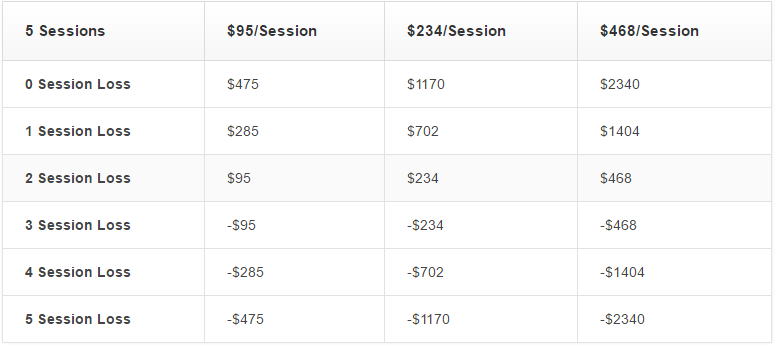
It is always best to stay as realistic as you can and not assume that you will win every session. The following table helps you understand why you don’t have to win every session and what your requirements are to stay profitable.


The numbers are clear and obviously you will prefer not to lose any session but you could lose 1 of 5 and still be doing quite well. A worse case scenario for you should be the losing of 2 sessions per 5 which still leaves you with some profit. After that you start heading to negative territory which probably means your trading strategy, or your ability to execute it, is not yet up to speed and you need to get back to studying and practicing for a while longer.

Let’s quickly run some more numbers based on the same concept and using the worst case scenario 70% payouts again.


Based on the above table being your session target, let’s see how that plays across 5 sessions.


With a 70% payout you need 14 winning trades to equate to a daily win, or 3 losses in a row to equate to a daily loss. With an 85% payout your wins needed per day to be a win is reduced to just 10, your daily loss remains the same though at 3 in a row. Those are the numbers and these days there is more and more competition in the Binary Options Broker world and higher returns are being provided than before. 70% really is the low end of what you will have to deal with and what you will find.


The Binary Options Martingale Worksheet


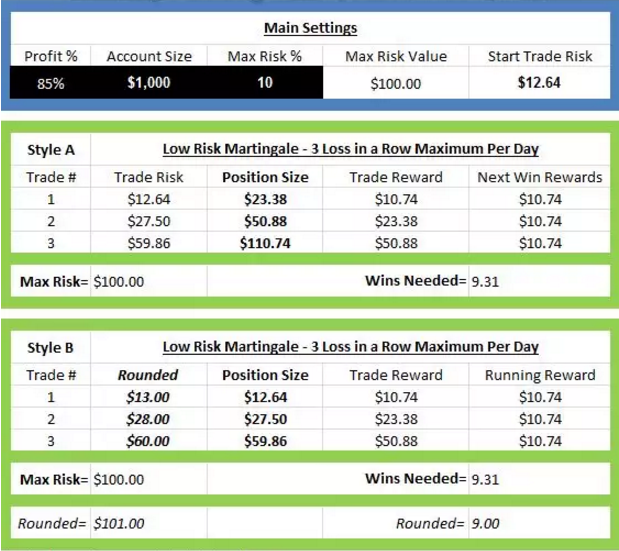
Here is a Binary Options Martingale Worksheet for you to use. It is an Excel file and all you have to do is enter values in to the top 3 black cells, the rest will be done for you. (click the image to download)


The Martingale Conclusion


If you have the correct skills you will find it hard to lose 3 in a row. Understanding your own daily or session capabilities will help you decide if this is even for you. Just remember that martingale trading also brings extra psychological issues along with it, if you are not confident in what you are doing then make sure you use a demo accounts to build some. Respect the martingale and spend the time to figure out if you should use it now or leave it to be revisited later on once you have more experience / personal results to study.

Compounding Your Profits

4:07 PM
•

Compounding Your Profits.

Making the Most of Your Win Streaks!


The Concept of Compounding


The idea behind compounding your profits as you make them can be extremely effective if your trading strategy is sound enough to produce winning streaks. As you make profits you can help combat the bad risk:reward of Binary Options by letting some of them ride and banking the rest. There is no limit as to how far you can take compounding but in order to keep things realistic you should not expect winning streaks to go on too long before encountering a loss. No matter how good your strategy you will have losses because that is just part of trading, however, if your strategy is good and you are good at executing it, or you have a good signal provider, you can make the most of the winning streaks.

Let’s take a look at how to compound your profits based on a 6 trade winning streak expectation and how it can effect your profits. This number 6 in the sequence is where it really starts to make a difference, expecting to win more than 6 in a row starts to become less and less likely, and even if you take this to 5 in a row and stop there, it still provides a good bonus. This time we will use an example of where you are getting 80% returns from your broker and using a $10 starting stake.


A rule of compounding is that once your target wins in a row is met you either stop or return back to trade #1. If at any point down your sequence you get a loss, you return back to trade #1. The easiest way to understand the difference that compounding introduces is to just look at the numbers side by side. We will use 80% returns again as our base and assume a $10 stake for basic trading. A $10 compounded start stake is also used again to replicate the compounding table results above.


Some days your Binary Options trading strategy may not even have 6 trades, this really depends on your strategy, and there is never any need to force a trade. This is how you will get the most losses, when you force it. The point is that even if you make it to 4 wins in a row and need to stop for the day compounding is still more profitable than basic stakes. If you make it to 5 or 6 where the gap expands on an exponential curve, the results start to make a big difference.


The Compounding Profits Worksheet


Here is a Compounding Profits Worksheet for you to use that runs to a very optimistic 8 streak. It is an Excel file and all you have to do is enter values in to the top 3 black cells, the rest will be done for you. (click the image to download)


So is Compounding for You?


The answer to this question requires you to have a demo trading history to analyse at the least, having a real money trading history to analyse would be best though. What are your longest winning streaks? What are your most common length winning streaks? and how often do you get them? The answers to all of those questions will help you decide. You really need to be getting 5 or 6 trade winning streaks to make the most out of compounding but you can still make a difference with 4. You can scale the above numbers as you wish according to your risk appetite and account size, a $10 starting stake is just realistic for many.

If you set your maximum loss each day to $20 and stuck to it, then went for 6 trade win streaks, the plan each day would be to gain $120 or lose $20, or finish the day with small profits if you didn’t lose $20 or get the streak. Whichever the case it is worth noting that 1 winning day would eliminate 6 losing days. That is something to think about!

Binary Options Basics

4:06 PM
•

Binary Options Basics

Understand the Numbers are Against You!


Understand the Basics of Binary Options Trading


The biggest problem with up/down binary options has always been the risk:reward nearly always being lower than 1:1 on each trade. There is only one broker offering up to 100% returns and even they do not offer these returns all the time. If you decide to approach a trading style with a lower than 1:1 risk:reward then you need to understand the numbers, it’s important to know what will be required from you to be profitable. I do not mean to insult your intelligence here but even these basics must be written down to guarantee awareness.

A very conservative approach for the examples here will be to assume a 70% return on your up/down trades, this is a very low return these days and you can usually find better. Check our Regulated Binary Options Brokers page for our recommendations. This next table just below will also assume some common trade sizes so that you can see at what win ratio you start to become profitable and at what amounts.


If you were to use the same trade size on every trade then you will need to win 60% of your trades to be profitable, but the amounts you will be making are very small and hardly worth the effort. In reality you will need to maintain an 80% or higher win rate to even consider trading this way. If you were playing big money you may be able to make do with 70% but the average person will not start off playing big money. The 70% returns that are used here are very low these days and you should be able to find 80% or higher. This will not change the fact that you need a higher than 70% win rate in order to make any decent money though.

So what you need to do first is to demo test your ability to execute your trading strategy and make sure that you can maintain your desired win ratio consistently for a period of time. Only then will it be safe for you to trade with real money because only then you will have the required confidence in your abilities. Let’s take a look at a few more common trade sizes and check the numbers.


Trading Psychology and Some Advice


After you have proven to yourself on a demo account that you are able to execute your trading strategy effectively, you will be ready to go live. If you stick with the above basics of just trading the same trade size each time, you know how the numbers work, the only thing left to overcome will be the psychology behind executing your plan with real money on the line. This will effect each person slightly differently but it will be a hurdle, even if it is the last hurdle. Most people rush the demo account / building confidence part of the plan and lose their money before they even get started, so please take this all seriously and don’t underestimate the weight of trading psychology at first.

In the next two lessons we will take a look at how you can use a little math to combat the bad risk:reward that the up/down binary options trades have. Both of these lessons are highly recommended but only providing you have a good deal of experience under your belt first. You will need your own trading history results to study before you can safely implement either.

Types of Binary Options

6:20 AM
•

Types of Binary Options.

Binary Options Come in Several Flavors!


Options Within the Binary Options!


So far we have only really taken a look at the high/low type of binary options and since there are so many different names for it we will just group them as up/down options. There are also touch/no touch binary options and range bound binary options so the choices are there. We only use the up/down binary options here at ElectroFX.com because they allow us scalp in the same way we would trade Forex longer term. This avoids the need to learn anything new and means that the one style of trading taught here can be used to trade the daily chart down to the tick chart. For the sake of being thorough let’s take a look at the different types on binary options so you know what is available.


Up/Down Binary Options


Our favorite are the up/down type of binary options and this type was used in the binary options example lesson that you should have already completed. These binary options are also know as high/low, rise/fall, or call/put. They are very simple and this is probably why they have the lowest payouts which usually range from 65-85% but we have found one binary options broker that offers up to 100% payouts also. You can visit them here.


The idea is as simple as selecting which direction you think price will go for a specified duration of time. This could range from hours to the whole day. or from minutes down to even just seconds. Different brokers offer different choices for time duration. Once you enter you will get your strike price and your chosen asset must close above, or below that depending on if you chose up, or down respectively. If you want to refresh your memory with before-during-after screenshots of a 30 second binary option then jump back to the binary options example lesson here


Touch/No Touch Binary Options


The next type of binary options trade requires you to specify a price that your chosen asset will touch, or will not touch, just like the name suggests. If you were to chose the touch binary option then the price of your chosen asset will need to touch your strike price at least once during the time duration selected. It will not matter if price stays above,or below, your strike price, it just needs to touch it before the contract expires. On the other side of the coin, a no-touch trade requires that the price of your chosen asset does not touch your strike price during the selected duration of time.

The touch/no-touch binary options generally have higher payouts then the up/down binary options and are often only available at certain times of the day. The risk:reward is very appealing with this type of trade but the trading opportunities per day are dramatically less. This type of binary options trade may suit some people but is not something that is pursued here.


Range Bound Binary Options


The last type of binary options trading involves trading ranges. The variations are to predict that the price of your chosen asset will stay within a specified range for the selected time period, or that the price of your chosen asset will end up outside a specified range for the selected time period. Just like all binary options trades this type is very easy to understand and very easy to execute. Just like the touch/no-touch type of binary options trade, this type of binary options trade may suit some people but are not pursued here .

When Binary Makes Sense

5:18 AM
•


When Binary Makes Sense.

Binary Options, Forex, or Both?


Which Style of Trading Suits You?


In the previous lesson we look at the pros and cons of binary options vs Forex and now you need to determine which best suits you. It may even turn out that both of them will suite you just fine and you just need to understand when each one makes more sense than the other. In order to determine all of that we must first pose a series of questions.


Are You Good With Computers and New Software?


Yes:

If you are good with computers and learning new software then both binary options and Forex remain possible for you. No matter which style of trading you chose you will need to learn how to actually read the price action on the charts, but with Forex you will need to also learn how to use more a more complicated interface/software than with binary options. Furthermore, if you are to trade Forex trading with serious money you will also need a VPS server to host the software and protect you from power failure and internet outages at home.

No:

If you answered no to this question then it may be the only question you even need to ask. Trading Forex requires you to not only learn about trading itself but also to learn new software. You may end up getting frustrated before you even start and sticking with binary options would probably be best for you. Just remember that the cost of taking the easy route is lower returns and the need to win a higher percentage of your trades. If you don’t understand why this is the case then don’t worry, you will by the end of this lesson.


What Speed of Trading Do You Prefer?


Intra-Day to Longer Term:

If you would like to trade anywhere from intra-day to longer term then both binary options and Forex remain possible for you. Forex will be more profitable though because many of these trades have a much higher than 1:1 risk:reward available, this also means that you could even get away with only winning 60% of your trades and still making a good profit. Binary Options will limit you to a set percentage that is usually always well below a 1:1 risk:reward and that means that you will need a much higher win ratio to see any profit. Both binary options and Forex at this pace can be traded in a set and forget fashion with minimal time and effort on your part.

Scalping / Fast Paced:

If you prefer more action and like to scalp the markets then the trading costs of Forex start to become an issue. The spread in particular becomes more and more important the faster you try and trade. With binary options there are no trading costs and no spread so they start to make more sense than Forex. The returns will still be below a 1:1 risk:reward but you would also have a hard time maintaining higher risk:reward with Forex.


What Kind of Risk Capitol Do You Have?


Minimal:

If your risk capitol is low then it really depends how low, some Forex brokers have extreme leverage and allow you to trade micro lots. For just $200-$300 you can safely trade micro lots when the leverage is good and it will allow you to play around with minimum risk per trade, $2.50 per trade would be an example if you were using a 25 pip stop loss. By trading Forex you may have the chance to make $5.00 from that $2.50 risk, if you trade with a binary options broker that allows such small amounts then you could only expect to make about $1.75 from your $2.50 risk. The bottom line is that both Forex and binary options remain available to you.

Plenty:

Once again both Forex and binary options remain available to you and it all boils down to your answer on the previous questions. Just make sure you stick to regulated brokers if you are investing large amounts and remember that even they sometimes they go bankrupt. Do your research and don’t trust just anyone with your funds.


When Does Forex Make Sense from a Logical Angle?


If you are looking to trade anywhere from intra-day and higher then Forex is clearly the best choice. Your risk:reward control along with not committing to a ‘time duration’ for each trade will allow you to often take trades that yield a 200-300% or higher return. That in turn will allow a lot of room for error since you will be able to be profitable winning even just 50-60% of your trades. At the very least you can never drop below a 100% return and be profitable with a 60% win rate. These are the benefits of adding the complications of learning new software and having to think about leverage, margin, commission, and spread, plus needing to think about getting a virtual private server (VPS).

When Do Binary Options Make Sense from a Logical Angle?


The first instance where binary options would make more sense is quite simply if you wanted to keep things as user-friendly as possible. Not everyone finds new programs easy to learn and trading binary options intra-day, longer term, or for scalping is all very possible. With anything other than scalping you will just have to accept that while you are making 70-80% returns others are making 100-300% returns on the same trade prediction.

The second instance where binary options makes the most sense is strictly for scalping, and this also applies to those who can trade Forex. When it comes to scalping small moves on any given asset the last thing you want to deal with is spread and commissions. The fact that binary options trading is so easy to do means that if you know how to trade Forex then binary options are child’s play. This is where you start to see the advantages of doing both because sitting down to scalp is hands-on no matter how you do it, intra-day to longer term Forex trading with the correct tools is set and forget and only takes minutes per trade.

 
Copyright © Forex Guide Pro. Designed by OddThemes | Distributed By Blogger Templates20